Disclosure: As an Amazon Associate I earn from qualifying purchases. This doesn’t change the price you pay or our recommendations. Learn more.
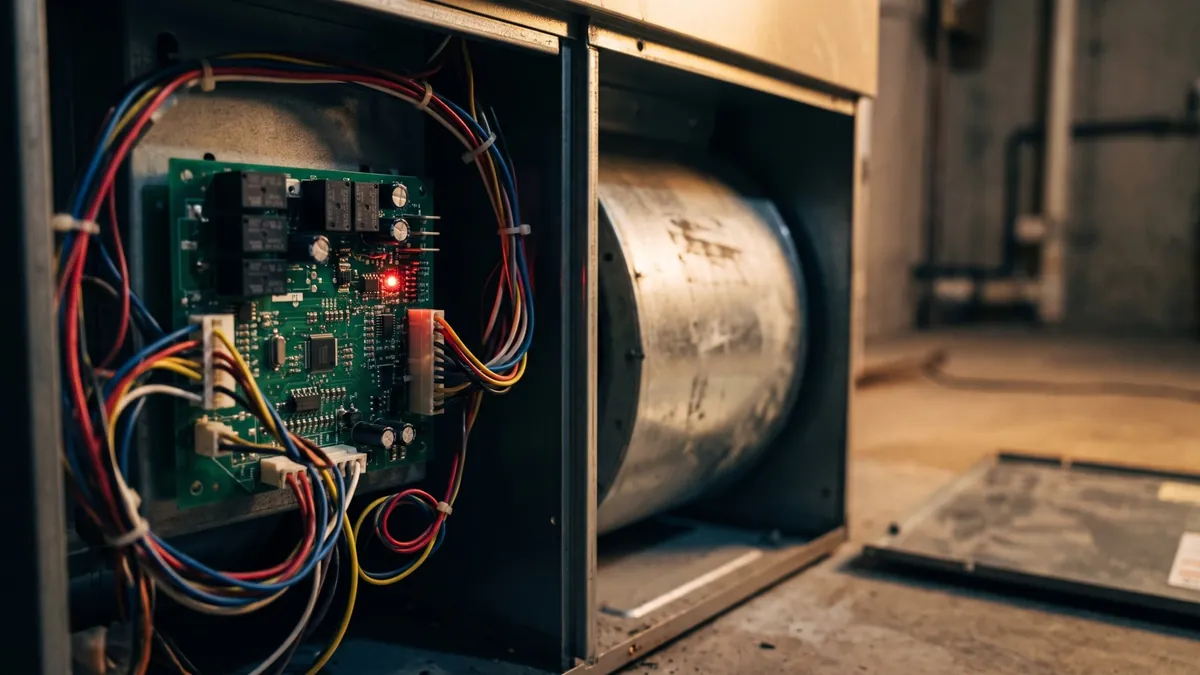
A blinking red light on your Goodman furnace is the control board’s diagnostic LED telling you what went wrong. Count the flashes between pauses and match the number to the chart below. On most Goodman single-stage furnaces, 3 flashes means the pressure switch didn’t close, 4 flashes means a limit switch opened, and 1 or 7 flashes usually points to a dirty flame sensor.
What is your furnace doing? Tap to jump to the fix.
Goodman has used more than one control board over the years, so the same number of flashes can mean different things on different models. The good news: the most common causes take 10–30 minutes to check and need only basic tools. Below, we show you how to confirm your code, then walk through the safe fixes, the exact parts you may need, and when it’s time to call a pro.
At a Glance
- What it means: The control board detected a fault and is repeating it as a flash count. A steady light is normal.
- Most likely causes: A dirty flame sensor (1 or 7 flashes), a blocked vent or pressure switch problem (3), or a clogged filter tripping the limit switch (4).
- DIY difficulty: Easy to moderate for filters, vents, and the flame sensor. Call a pro for 2, 5, or 6 flashes.
- Time needed: 10–30 minutes for the common fixes.
- Typical cost: $10–$60 for a DIY part · $80–$375 for most professional repairs.
Pro Tip: Count the Flashes Before You Open the Door
Read the code through the small viewing window on the lower blower door first. Goodman’s GKS9 manual notes that the flash code stops if power to the control board is interrupted by the disconnect or the door switch, so removing the door can erase the clue you need. Write the number down or record a short video.
In this guide
What a Blinking Red Light Means on a Goodman Furnace
Most Goodman gas furnaces have a red diagnostic LED on the integrated control board, visible through a small window in the blower door. A steady light means normal operation. A flashing light repeats a fault code: it blinks a set number of times, pauses, then repeats.
If the board can’t light the burners after three tries, it locks out and shows 1 flash. According to Goodman’s troubleshooting chart, the control then tries to reset itself from lockout after one hour. A furnace that “fixes itself” an hour later still has a problem worth checking.
Check Which Goodman Board You Have
- Single-stage furnaces (most common): use the main chart below. It comes from Goodman’s GKS9 troubleshooting chart and matches many single-stage models.
- Two-stage and variable-speed furnaces (for example, GMV9): several codes shift. Use the second table.
- Some older boards: on the GMS8 troubleshooting chart, 2 flashes means an open auxiliary limit instead of a pressure switch problem.
- Newer models with a digital display (GM9S80 and GC9S80): these show codes such as EE0–EE6 on a small display instead of blinking, and store the last six faults in an “L6F” menu.
The fastest way to be sure is to read the code label inside the blower door. It’s written for your exact board.
Goodman Furnace Flash Code Chart
| Code / Flash Pattern | Fault Name | Most Likely Cause | DIY Difficulty | Est. U.S. Pro Cost |
|---|---|---|---|---|
| Steady on | Normal operation | No fault | — | — |
| Off | No power to the control board | Switch or breaker off, door switch open, blown 3-amp board fuse | Easy | Varies |
| 1 flash | Lockout after 3 failed ignition tries | Dirty flame sensor, bad igniter, no gas to burners | Easy–Moderate | $80–$250 |
| 2 flashes | Pressure switch stuck closed | Sticking switch contacts or a short in its wiring | Pro | $150–$350 |
| 3 flashes | Pressure switch stuck open | Blocked vent or intake, clogged drain, cracked hose, weak inducer | Moderate | $150–$350 (switch) $400–$1,100 (inducer) |
| 4 flashes | Primary or auxiliary limit open | Dirty filter, closed vents, blower problem, faulty limit | Easy | $100–$375 |
| 5 flashes | Flame sensed with no call for heat | Short in the flame sense circuit or a slow-closing gas valve | Pro | $200–$800 |
| 6 flashes | Rollout limit open | Blocked flue, misaligned burners, failed inducer | Pro | $100–$375 (switch) |
| 7 flashes | Low flame signal (furnace still runs) | Dirty or misplaced flame sensor, low gas pressure | Easy | $80–$250 |
| Rapid, continuous | Reversed polarity or poor ground | 115V or 24V wiring reversed, bad ground | Pro | Varies |
Two-Stage and Variable-Speed Goodman Codes
Two-stage furnaces such as the GMV9 use a different chart. These codes are confirmed in Goodman’s GMV9 manual:
| Flashes | What It Means |
|---|---|
| 2 | Primary or auxiliary limit circuit open |
| 4 | Rollout limit circuit open |
| 5 | Flame sensed with no call for heat |
| 7 | Low flame sense signal |
| 8 | Problem with the igniter circuit |
| 9 | High-stage pressure switch didn’t close |
| Continuous | Reversed 115V polarity or poor ground |
How to Fix It: Step by Step
Safety Cutoff: Do This Before Any DIY Step
- Power: Turn off the furnace service switch (it looks like a light switch on or near the unit) and the circuit breaker.
- Gas: Before working near the burners, turn the gas valve or the shutoff on the supply pipe to OFF.
- Smell gas (rotten eggs)? Don’t touch any switch or the thermostat. Leave the home now and call 911 or your gas utility from outside.
- CO alarm sounding? Get everyone into fresh air and call 911. Don’t go back in until responders say it’s safe.
Start with the step that matches your flash code. The steps run from the easiest, most common fixes to the ones that need more care.
Step 1: Check the Air Filter and Vents (4 Flashes)
- Pull the filter at the furnace or return grille. If you can’t see light through it, replace it.
- Open the supply registers and move furniture away from return grilles.
- Restore power and watch the LED through the window. If 4 flashes return within a few cycles, the limit switch or blower needs a technician.
With 4 flashes, Goodman’s chart notes the circulator blower runs continuously with no furnace operation. That’s why you may feel cold air from the vents while the code is active.
Step 2: Clean the Flame Sensor (1 or 7 Flashes)
- Turn off power at the service switch and breaker, and turn the gas to OFF.
- Remove the upper burner door. The flame sensor is a thin metal rod that sits in the burner flame, held by one screw.
- Remove the screw and slide the sensor out without bending it.
- Lightly polish the rod with emery cloth until it’s clean and bright, as Goodman’s manual recommends. Don’t touch the igniter; it’s fragile.
- Reinstall the sensor, restore gas and power, and run a heat cycle.
If the code comes back soon after cleaning, the sensor may be worn out. A replacement Goodman flame sensor (0130F00010S) is inexpensive and takes about ten minutes to swap.
Step 3: Check the Vent Pipes, Hose, and Drain (3 Flashes)
- Outside, check the vent and intake pipe ends for snow, ice, nests, or debris.
- Inside, find the small rubber hose between the pressure switch and the inducer motor. Look for cracks, kinks, water, or a loose end.
- On high-efficiency (90%+) furnaces, check that the condensate drain and trap aren’t clogged. Goodman lists a blocked drain system as a cause of this code.
- Listen for the inducer motor. If it doesn’t start or sounds rough, call a technician.
Step 4: Check the 3-Amp Board Fuse (Light Off)
- Turn off power at the service switch and breaker.
- Find the small automotive-style fuse on the control board. Goodman specifies a 3-amp automotive fuse.
- If the metal strip inside is broken, replace it with the same 3-amp fuse.
- If the new fuse blows again, there’s a short in the low-voltage wiring, often a thermostat or outdoor-unit wire. Call a technician.
Step 5: Reset the Furnace the Right Way
- After fixing the cause, turn the service switch off for about 30 seconds, then back on.
- Set the thermostat a few degrees above room temperature and watch the LED through the window.
- Don’t keep resetting a furnace that shows 6 flashes. Goodman ties that code to blocked venting, misaligned burners, or inducer problems, which need a professional inspection.
Parts & Tools You May Need
Exact Replacement Parts & Tools
First, find the model and serial number sticker inside the blower door. Match the part number on your old part before you order.
Goodman Flame Sensor 0130F00010S — for 1- or 7-flash codes when cleaning doesn’t help
Fits: many Goodman and Amana furnaces, including GMS8, GDS8, and GCSS96 models · Replaces 0130F00010 and B1172606
Goodman Hot Surface Igniter B1401018S — for 1-flash lockouts when the igniter never glows
Fits: Goodman and Amana furnaces that use B1401018S · Replaces B1401015S and B1401009S
3-Amp Automotive Blade Fuse — for a control board with no light at all
Fits: Goodman integrated control boards (3A automotive fuse)
Emery Cloth — for cleaning an oxidized flame sensor
Fits: any furnace flame sensor
When to Stop and Call a Pro
Stop DIY and Call a Licensed HVAC Technician If…
- The LED shows 2, 5, or 6 flashes. These involve safety switches, flame rollout, or the gas valve.
- The LED flashes rapidly and continuously, which points to reversed polarity or a bad ground.
- The 3-amp board fuse keeps blowing.
- You smell burning, or see scorch marks or melted wiring.
- You suspect a cracked heat exchanger (rollout trips, soot, or a CO alarm). This is a carbon monoxide risk.
- The code comes back after you’ve done every safe check in this guide.
For other brands, see our full list of furnace codes.
Frequently Asked Questions
What do 4 flashes mean on a Goodman furnace?
On most Goodman single-stage furnaces, 4 flashes means the primary or auxiliary limit circuit is open because the furnace overheated. The usual cause is restricted airflow from a dirty filter, closed vents, or a blower problem. The blower keeps running with no heat. Replace the filter first; if the code returns, call a technician.
What do 6 flashes mean on a Goodman furnace?
Six flashes means the rollout limit circuit is open, meaning flames rolled out of the burner area. Goodman links it to a blocked flue or air inlet, misaligned burners, or a failed inducer. Rollout switches usually need a manual reset, but don’t reset it repeatedly; have a technician find the cause, since it can signal a carbon monoxide risk.
What does the 5-flash code mean on a Goodman furnace?
Five flashes means the board sensed a flame when there was no call for heat. Goodman lists a short to ground in the flame sense circuit or a gas valve that closes too slowly. Both blowers may run continuously. This is not a DIY repair; turn the furnace off and call a licensed technician.
How do I clear the error code on a Goodman furnace?
Fix the cause first, then turn the furnace service switch off for about 30 seconds and back on. That clears the blinking code. A lockout (1 flash) also tries to reset itself after one hour. On newer Goodman furnaces with a digital display, stored faults can be cleared from the “L6F” menu.
Why does my Goodman furnace blink 1 time and won’t ignite?
One flash means the furnace locked out after three failed ignition tries. The most common cause is a dirty flame sensor, followed by a cracked igniter or no gas reaching the burners. Clean the flame sensor first. If the igniter doesn’t glow orange during startup, it likely needs replacing.
What does a steady or constantly blinking red light mean?
A steady red light that doesn’t blink means normal operation. A light that flashes rapidly and continuously without pausing means the 115-volt or 24-volt polarity is reversed or the furnace has a poor ground. That’s a wiring problem for a licensed technician.
What do 8 flashes mean on a Goodman furnace?
On two-stage Goodman furnaces such as the GMV9, 8 flashes means a problem with the igniter circuit: a bad or loose igniter connection, a failed igniter, or a poor ground. Single-stage boards don’t use an 8-flash code, so check the label inside your blower door to confirm.
Sources & Verification
- Goodman GKS9 Installation & Operating Instructions, troubleshooting chart, pp. 34–35.
- Goodman GMV9 Installation Instructions, troubleshooting chart, p. 38.
- Goodman GMS8 Installation & Operating Instructions, troubleshooting chart, p. 29.
- Goodman *M9S80 & *C9S80 Installation Instructions (IOG-2030B), status and troubleshooting codes, pp. 26–29.
- Repair cost ranges: Trane and HomeGuide.
Written and fact-checked by the HomeUnitCodes Editorial Team. Last checked: November 2026.